Sunday, March 18, 2018

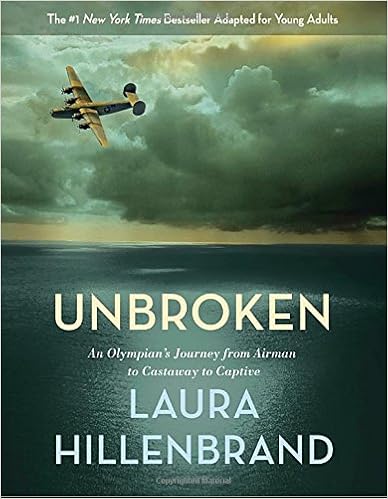
Finished (E-Reader): Unbroken: A World War II Story of Survival, Resilience, and Redemption by Laura Hillenbrand


Louis Zamperini also went on to fight in the Pacific air war in WWII.  He survived a severe amount of damage on a mission, and later crashed into the Pacific, far from allied forces.  Survived for a record amount of time with two other crewmates, one of which didn't make it through this phase of the story.  Captured and tortured by the Japanese, returned to the U.S. haunted by his experiences.  Found a young Billy Graham and managed to find a route to forgiveness.

Unbroken is an amazing story of an Italian-American growing up in a time when Italians were a new minority, with all the associated baggage and bigotry that new immigrant waves had to deal with in a growing America.  The man, Louis Zamperini, went on to become an Olympic athelete, who may have (had not WWII intervened) become the first sub 4-minute miler, competing at the 1936 Olympics (the Jesse Owens - Adolf Hitler Berlin Olympics).

That story, alone, the training, overcoming adversity, travails of hot summers without air conditioning, travel times needed to reach international events; this alone would have been a good book.


I had seen the movie a few years before, but didn't make the initial connection.  However, as several scenes were lifted directly from the book to the screen, the images evoked from the book seemed oddly cinematic.

Definitely a good read, and a profile of an amazing life.

Sunday, February 26, 2017

Finished (Paper Book) - "One Minute to Midnight" - Michael Dobbs


 http://media.npr.org/assets/bakertaylor/covers/o/one-minute-to-midnight/9781400043583_custom-46d5e2c31288c1d5e73d254d6c210e43b4ff49c5-s6-c30.jpg

I picked up "One Minute to Midnight" at a very cool bookstore in Manhattan on Broadway near the Museum of Natural History.  I thought he book was "old" - maybe mid '70s but was surprised to find it was actually written in 2008.

The book is coverage of the Cuban Missile Crisis in October 1962.  The book was well timed, in that some of the information was not available in the 60's 70's or even up to 2000, so the book covers the topic even better than contempory accounts could have.

One big surprise for me was the number of Soviet troops in Cuba in 1962 - the U.S. figured a few hundered to a few thousand but there were 40,000 battle ready troops available for use if the U.S. invaded Cuba.

Further, the U.S. was aware, through U2 spyplane pictures, of the medium range missiles being deployed into Cuba, which was the genesis for the crisis.  What they did not know was where the warheads were stored - there didn't appear to be any appropriate warhead storage depots visible, which led the U.S. to believe they hadn't been delivered yet.  However, there were nuclear warheads on site in Cuba, not yet delivered to the missiles, but in storage immediately adjacent to the port where they arrived.  U.S. overflights saw this storage, but did not believe it was secure enough for nuclear material, so dismissed the evidence for that being the warheads.

Another astounding surprise was that the Soviets had deployed battlefield nukes - these have a yield of about 1000 yards (radius) which can take out a aircraft carrier group, or can take out the entire Guantanemo Bay base (in face, there were Soviet agents, armed with these battlefield nukes, overseeing Guantanemo, in order to take it out if the U.S. attacked).

Communication between the U.S. and the U.S.S.R. was rudimentary in 1962 - I believe the "hot line" was installed due to this crisis.  Much of the deplomacy was handled through reporters and "known" spys, and "official" communicaton often took a day or more to be created, translated, sent, processed and received.  Both sides used broadcast media to announce intentions and to understand the "other" side.  This mismash of communication led to dangerous estimates and best-guess intentions being inferred.

The U.S, when they established the blockade of Cuba, informed the Soviets that they would stop and board any craft approaching Cuba, including submarines.  If submarines were discovered, the U.S. would lob "practice depth charges" or other smaller-scale munitions to identify to the sub that they were to surface for inspection (or presumably to turn around).  However, the U.S.S.R. did not forward this message to their crews, so when the U.S. ran across a submarine, and began the munitions, the crew was unaware that this was merely a crude communications mechanism.  The sub had a nuclear tipped torpedo, which had to be launched with the agreement of the polictical officer and the captain - they actually loaded and were debating firing the nuclear torpedo when the crew toned down the rhetoric and the sub surfaced.

As the crisis occurred before I was born, I didn't know all the details - I didn't know that a U2 plane was shot down during the crisis over Cuba (by Soviet, not a Cuban crew - not sure when that distinction was made to the U.S.) and that an unrelated U2 mission over the north pole went askew and the U.S. U2 was 900 miles or so over Soviet territory off Alaska.  This even triggered MiGs to take off from two bases to chase away the U2 and could easily have led to a misunderstanding of immense magnitude (e.g. could have been seen as a bomber strike, or as a precursor flight of a spyplane to prepare for attack on the U.S.S.R.).

In hindsight, we are all very lucky to be around.  The failsafes on both sides were not as strong as they (hopefully) are now - the U.S. Minutemen silos in the mid-west are designed to have two launch personnel in order to be launched - as they were just on the verge of being deployed, there was a push to move up the timetable to make them launchable - one way they did so was to link together the two launch mechanisms to work around the incomplete setup - basically one button launch.

All in all, a great read.  The Cuban Missle Crisis was the 9-11 for an earlier generation, and rightly so.  We were only one mistep or miscalculation from the start of a war unlikely to be contained to the Caribbean, with almost immediate impact on Berlin, Turkey and Italy (Turkey and Italy had U.S. outdated missiles in place, very close to the U.S.S.R.) and likely U.S. to U.S.S.R. in a difficult to stop escalation.


Finished (Paper Book) - "Bit Rot" by Douglas Coupland


http://images.gr-assets.com/books/1475363775l/32327836.jpg

I received "Bit Rot" for Christmas and got around to reading it over the last few week.  The book is a collection of articles, play sketches etc. and is a nice summer-type read, as you can pick up and put down as time allows.

I did enjoy the book, but to be honest, not much has "stayed" with me, which has advantages - I can read it again if I like.

Monday, December 12, 2016

Discovered "House of Lies" - Showtime


Image result for house of lies

I must begin reading blogs of CURRENT programs, I seem to be drawn to blogs identifying programs that are cancelled.

Thus, I found "House of Lies" which has been cancelled after five seasons.

Don Cheadle plays Marty Kaan, a successful management consultant, supported by Jeannie (Kristen Bell), Doug (Josh Lawson) and Clyed (Ben Schwartz).  Though a typical lighthearted drama, Cheadle, through occassional asides to the audience, illustrates the cut-throat and often vacuous world the characters inhabit.
Definitely an adult series, with strong language and occassional nudity, the series is compelling to watch and the characters, both co-workers and clients are interesting.

Marty's private life has a son, Roscoe (Donis Leonard Jr.) who is a mid-teen dealing with a modern, complex gender identity, an ex-wife, Monica (Dawn Oliveri) who is also a cut-throat management consultant at a rival firm and a live-in retired analyst father, Jeremian (Glynn Turman).  Marty's homelife provides a nice foil to his work and adds complexity to his character that might be missed if only the office-life was portrayed.

Finished (E-Reader): "Sapiens: A Brief History of Humankind" - Yuval Noah Harari


I quite liked "Sapiens".  Like most folks, I always assume (wrongly) that evolution runs forward in a positive direction.  "Sapiens" shows that the actuality is really more mixed than that.
Harari points out some other details that I hadn't considered.  Hunter-gatherers did not spend all of their time hunting and gathering - they likely spent fewer hours per week in those activities than current homo sapiens spend in their worklife.  Thus, our ancestors probably had very active social lives, and the social aspects prove to be the most important parts of our dominance.  Sapiens A Brief History of Humankind.jpg


Homo Sapiens may prove to be a larger "extinctionator" that even the largest asteroid, particularly with respect to large land mammals, which we seem to hunt to extinction on every continent soon after we arrive on the scent.


I kind of knew theories of the origins of myth and religion, but hadn't realized their power to unite larger groups of people than more direct social interactions allow.  Harari explains that social groups begin to fall apart when you get to the 100's.  I tend to think about a primary school, where there may be a few hundred students, and the K-3 or 6-8 grade levels form a sort of community and know each other, but when you get to a large high school, the groups are broken down more, as the grades are too large for all students to know each other.  Harari attributes the power of myths and legends to allow strangers to align even without personal connections (e.g. cultures, tribes, religious factions) all of which allow Sapiens to combine in large enough groups to overcome hurdles that would knock down the largest of pre-existing species, who would operate as smaller family groups or extended herds (elephants, for example).

I had not considered the pros and cons of moving from hunter-gatherer to farming in any particular detail.  Planting caused some learning to be rewarded (e.g. tracking seasons, learning how to plant effectively) but along with the loss of mobility came the need to create permanent shelter, which, in turn, lead to defense of land and possessions, which could now be kept and stored.  This also led to organization of people to defend land from wondering troops of hunter/gatherers or other species of man or animal that would threaten the now "owned" land.  Further, I had assumed that the trade-off was universally positive - farming was inevitable growth of the species (and in terms of # of bodies, it was), but didn't recognize that the reliance on singular crops cost a lot in terms of physical health and was susceptible to drought or plague in ways that hunting and gathering was less susceptible to.  However, staying in place allowed for large families, which were needed to farm, an allowed enough bodies to be born to handle very excessive mortality (e.g 1/3 or 1/2 of children dying young).  These large families also proved to swing the balance toward continued farming as farmers with extended family groups would always outnumber roving hunter-gatherers, which reduced the land for gathering, and the #'s favoured farmers in any battles that might occur.

Each of the four revolutions of humankind (Cognitive, Agricultural, Unificaiton, Scientific) is explained simply, clearly and with insight to make the transitions' importance visible and clear.